Maryland’s Thomas Viaduct is the oldest bridge on our list: its eight stone arches have carried trains over the Patapsco River since 1835. The other nine, from a cast-iron footbridge in Central Park to the Golden Gate, were all finished by 1937 and are still admired as much for their beauty as for their age.
Stone viaducts, a wooden covered bridge, steel arches and soaring suspension spans all appear here, set against rivers, canyons, city skylines and the Pacific coast. Every one of them is still in use, and each makes a memorable stop on a trip across America.
How we chose these
We chose ten historic bridges, all at least 85 years old, that are widely admired for their design and setting. Most are recognized by the American Society of Civil Engineers as historic landmarks or listed by the National Park Service. The countdown runs from the youngest at #10 to the oldest at #1, using the year each bridge opened or was completed; choosing for beauty is our editorial judgment. For earlier road crossings, see our list of the oldest bridges in America.
| No. | Bridge | State | Opened | Crosses |
|---|---|---|---|---|
| 1 | Thomas Viaduct | Maryland | 1835 | Patapsco River |
| 2 | Starrucca Viaduct | Pennsylvania | 1848 | Starrucca Creek |
| 3 | Bow Bridge | New York | 1862 | The Lake, Central Park |
| 4 | Cornish–Windsor Covered Bridge | New Hampshire–Vermont | 1866 | Connecticut River |
| 5 | Eads Bridge | Missouri–Illinois | 1874 | Mississippi River |
| 6 | Brooklyn Bridge | New York | 1883 | East River |
| 7 | Colorado Street Bridge | California | 1913 | Arroyo Seco |
| 8 | Bixby Creek Bridge | California | 1932 | Bixby Creek |
| 9 | Deception Pass Bridge | Washington | 1935 | Deception Pass |
| 10 | Golden Gate Bridge | California | 1937 | Golden Gate strait |
10. Golden Gate Bridge, California
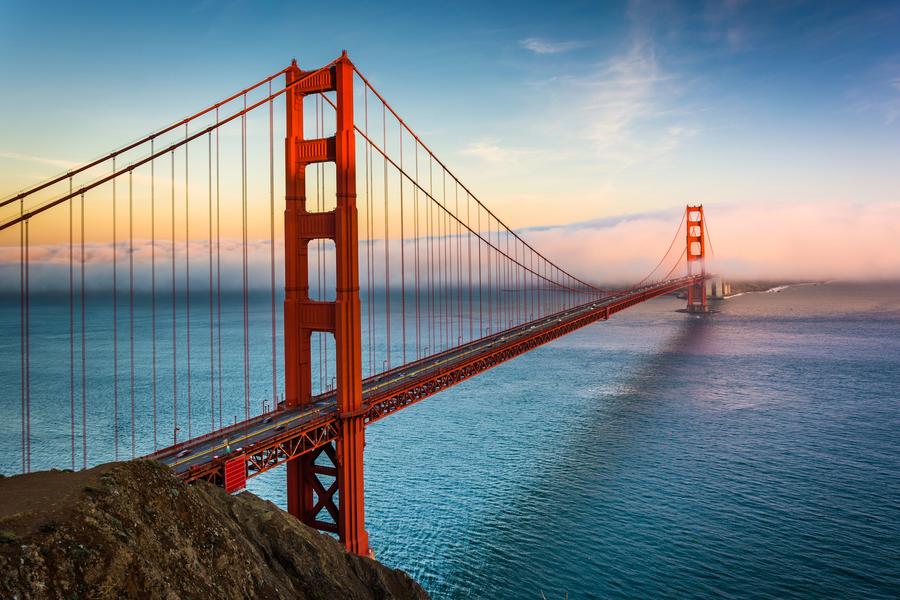
The Golden Gate Bridge set world records for the longest span and the tallest towers when it was finished in 1937. Its main span stretches 4,200 feet (1,280 m) between towers that rise 746 feet (227 m) above the water, and its International Orange paint glows against the fog and the blue of San Francisco Bay.
The bridge opened to pedestrians on May 27, 1937. Cars followed at noon the next day, when President Franklin D. Roosevelt pressed a telegraph key in the White House. The bridge district estimates 34.3 million vehicle crossings in the year ending June 30, 2026, counting traffic in both directions. The Golden Gate held its main-span record until 1964. Our list of the longest suspension bridges traces the spans that followed.
9. Deception Pass Bridge, Washington
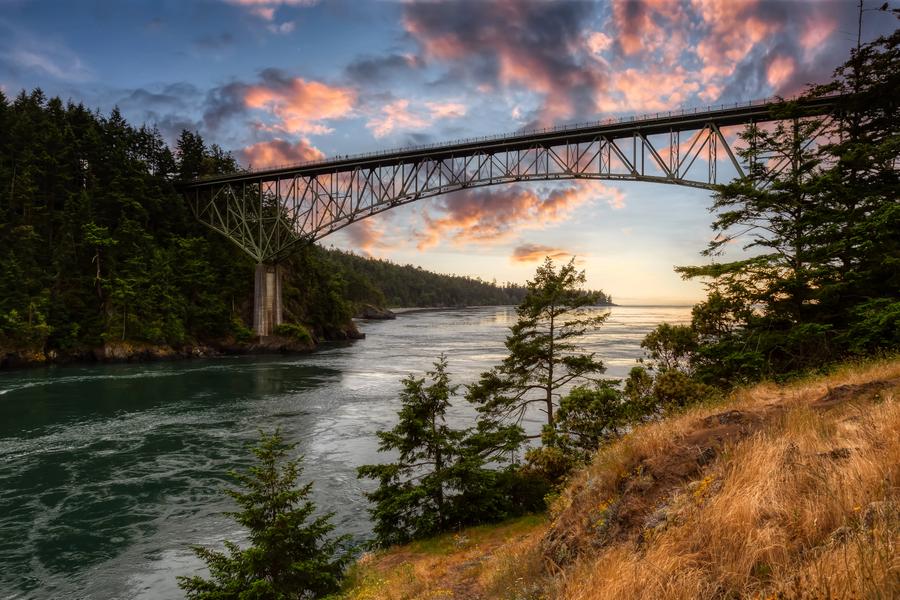
Deception Pass Bridge leaps across a narrow, swirling channel in the Salish Sea, and it was dedicated on July 31, 1935. It is really a pair of steel spans: Deception Pass Bridge links Whidbey Island to tiny Pass Island, and the shorter Canoe Pass Bridge carries the road on to Fidalgo Island. From the deck, the view drops to fast tidal water, rocky cliffs and dark green forest.
Engineer O. R. Elwell designed the crossing, and Puget Construction Co. of Seattle built it with New Deal state and federal money. Young men of the Civilian Conservation Corps blasted rock and prepared the access roads in the surrounding state park. Before the bridge, Berte and Augie Olson’s ferries shuttled cars across the water. Even the larger boat, Acorn, could take only sixteen cars at a time. The new road made it possible to cross on a driver’s own schedule.
8. Bixby Creek Bridge, California
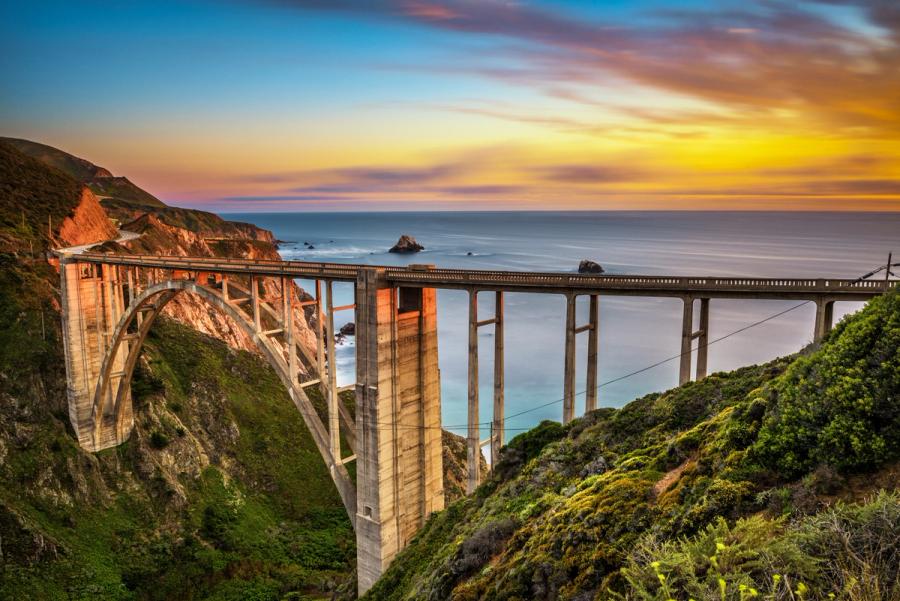
Bixby Creek Bridge, built in 1932, arches over a deep canyon where Big Sur’s mountains meet the Pacific. Its concrete main arch spans 330 feet (101 m), according to California’s historic bridge inventory. Look beneath the level roadway and you can trace the arch from one rock face to the other. The narrow columns above it leave enough daylight between them to see the ocean through the bridge.
Building Highway 1 along this stretch of Monterey County meant crossing one steep ravine after another. California’s highway engineers used a series of concrete arches here in the 1920s and 1930s. Bixby was the largest of that Big Sur group. In a broadside view, the straight road deck gives a sense of scale that is easy to lose from a moving car.
7. Colorado Street Bridge, California
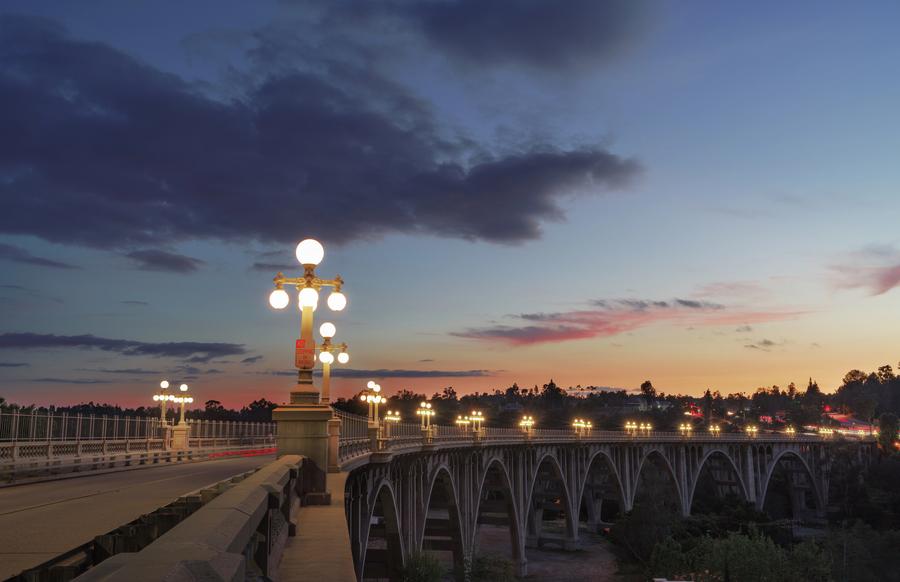
Pasadena’s Colorado Street Bridge was proclaimed the highest concrete bridge in the world when it was completed in 1913. Its arches rise 150 feet (46 m) above the Arroyo Seco. The deck follows a 50-degree curve, a shape that let the builders place the foundations on firmer ground. Along the sidewalk, clusters of round lamps sit on ornate cast-iron posts above rows of classical balusters.
Engineer John Drake Mercereau conceived the design, and the bridge took 18 months to build. Earlier travelers had to descend one side of the arroyo, cross the stream, then climb out again. Route 66 used the high crossing until the Arroyo Seco Parkway opened in 1940. After a seismic rehabilitation, the bridge reopened in 1993 with its distinctive lamps and railings.
6. Brooklyn Bridge, New York
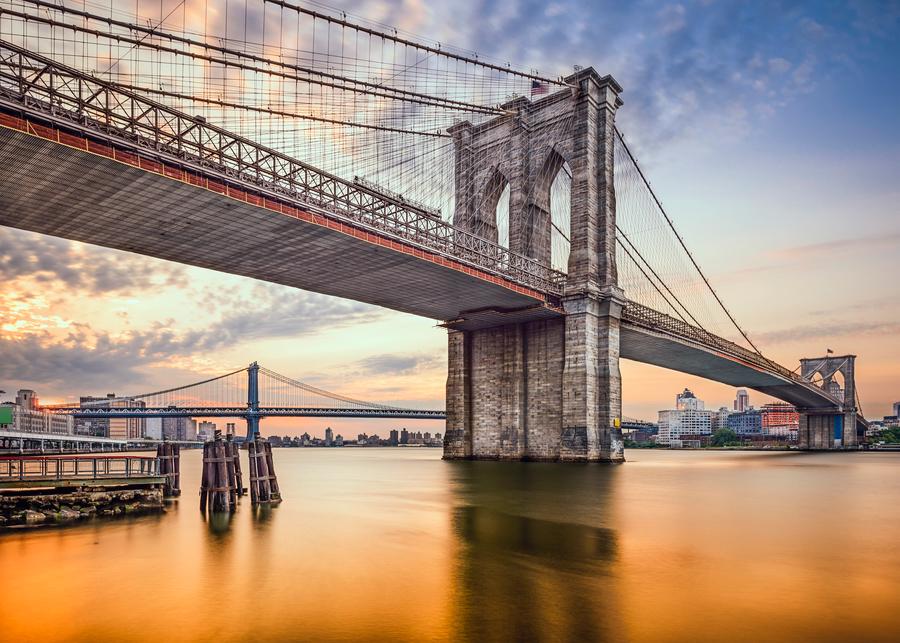
When the Brooklyn Bridge was completed in 1883, it was the longest suspension bridge in the world, with a main span of 1,595.5 feet (486.3 m) over the East River. Designed by John A. Roebling, it is famous for its stone towers with pointed arches and the web of steel cables fanning out above the walkway. Few views of New York beat Manhattan’s skyline framed by those arches.
Construction began in 1869 and lasted 14 years. Today the bridge carries five lanes of cars (no trucks), plus a raised pedestrian promenade and a protected bike path. In 2024 it averaged 103,051 vehicles, 28,845 pedestrians and 5,504 cyclists a day, according to the city’s Department of Transportation. Walking across at sunrise, before the crowds arrive, is still one of the best free experiences in the city.
5. Eads Bridge, Missouri and Illinois
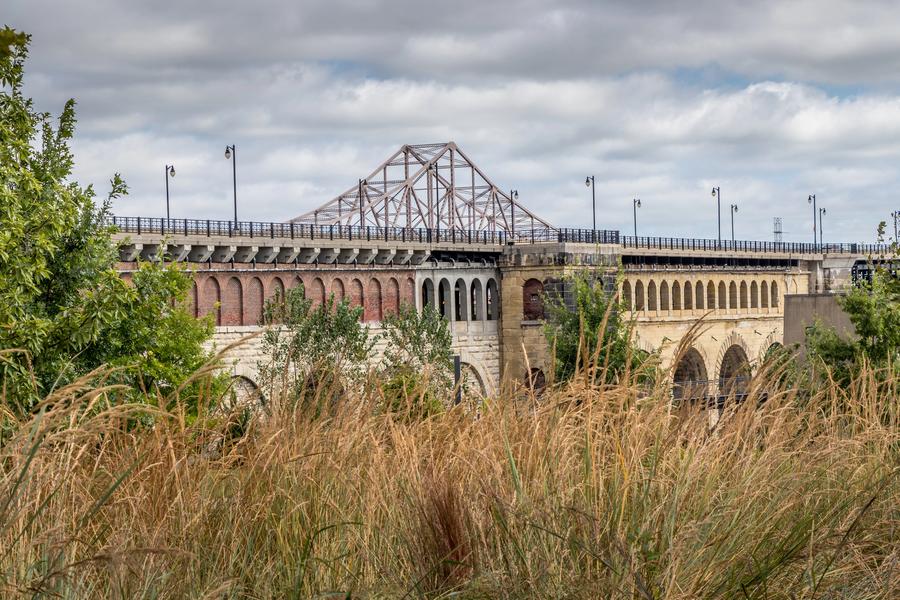
St. Louis’s Eads Bridge was completed in 1874, and the National Park Service calls it the oldest bridge standing on the Mississippi River. Three ribbed steel arches carry it across the river, and with the Gateway Arch rising behind it, the view from the riverfront is one of the most striking in the Midwest.
James Buchanan Eads designed and built it, using the first large pneumatic caissons in the United States to reach bedrock deep below the riverbed. Work took seven years and cost $7 million. Before the opening, a test loaded the bridge with fifteen 50-ton locomotives. Trains still cross here today. MetroLink uses the crossing between Missouri and Illinois, while pedestrians and road vehicles travel on the upper deck.
4. Cornish–Windsor Covered Bridge, New Hampshire and Vermont
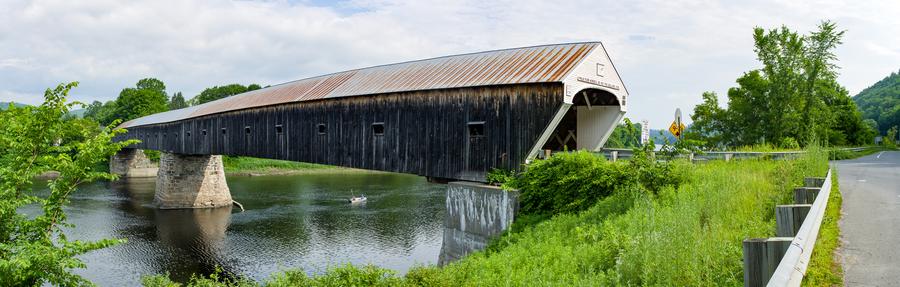
The Cornish–Windsor Covered Bridge crosses the Connecticut River in two long wooden spans. James Tasker and Bela Fletcher built it in 1866 after floods had destroyed three earlier crossings here. They framed the timbers in a nearby meadow before moving them into place over the river. Seen from the bank, the long roof reflects in the water like a second shoreline.
Inside, diagonal timbers cross one another to form a lattice that supports the roadway. The design goes back to a truss patented by Ithiel Town in 1820. The bridge originally cost $9,000. New Hampshire bought it in 1936 and collected tolls until 1943. Drivers still use it to travel between Cornish, New Hampshire, and Windsor, Vermont.
3. Bow Bridge, New York

Bow Bridge, built between 1859 and 1862, is a cast-iron footbridge shaped like an archer’s bow, spanning more than 60 feet (18 m) of the Lake in Central Park. The park’s own conservancy calls it a masterpiece of Victorian-era design and one of the park’s most photographed features. Its pale arch, mirrored in the water, looks lovely in every season.
The bridge connects Cherry Hill with the wooded paths of the Ramble. Calvert Vaux’s design lets a walker see the Lake through the open iron railing. At each end of the crossing a row of ornamental urns marks the entrance. Those urns once disappeared from the bridge. The Central Park Conservancy restored them as part of a series of repairs that also renewed the deck and abutments.
2. Starrucca Viaduct, Pennsylvania
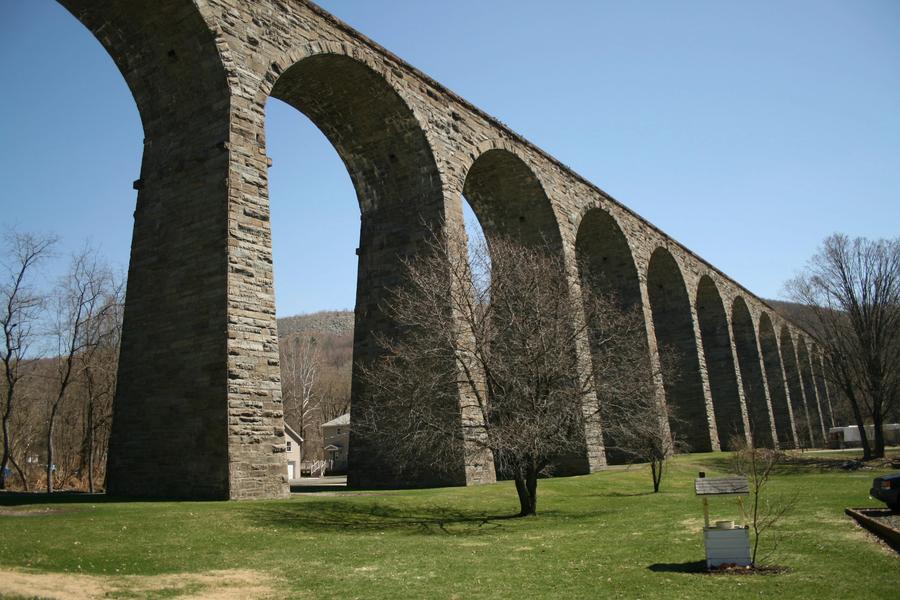
The Starrucca Viaduct, finished in 1848, carries a railroad across a green valley in Lanesboro, Pennsylvania, on 18 slender stone arches, each spanning 50 feet (15 m). It rises 110 feet (34 m) above Starrucca Creek, and from the valley floor its tall, rhythmic arches look almost like a Roman aqueduct set among the hills.
It was the key masonry viaduct of the New York and Erie Railroad, and at $320,000 it was believed to be the most expensive railroad bridge in the world. More than 800 workers, paid $1 a day, finished it in about a year. The American Society of Civil Engineers also counts it among the first, if not the first, important engineering works to use structural concrete. Autumn color makes the valley especially beautiful.
1. Thomas Viaduct, Maryland
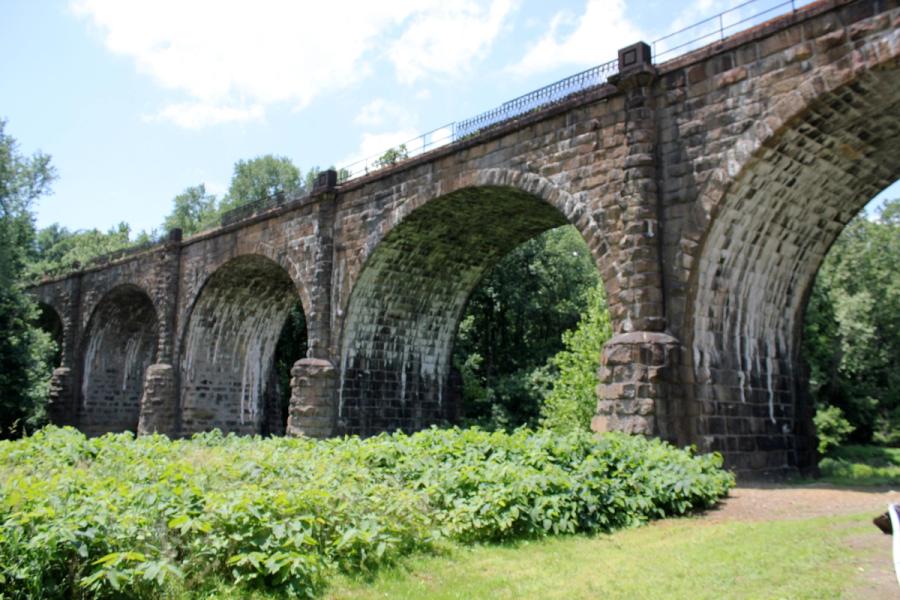
The Thomas Viaduct opened in 1835 and was the first multiple-arch stone railroad viaduct in the United States. Its eight stone arches, each about 58 feet (18 m) wide, carry the line 60 feet (18 m) above the Patapsco River near Relay, and the whole 614-foot (187 m) bridge bends gently along a curve.
Benjamin Henry Latrobe Jr. designed the viaduct for the Baltimore and Ohio Railroad. During construction, skeptics called it “Latrobe’s Folly.” Nearly two centuries later, CSX freight trains and MARC passenger trains still use it. For a view from below, Maryland’s park service points visitors to the valley floor near the Avalon entrance to Patapsco Valley State Park. From there, the spaces between the piers reveal the gentle bend in the line.